5G Wireless Upgrades Reshaping Real-Time Decision Timing in Remote Table Game Networks
Willa Jenkins · Aug 4, 2026

5G Wireless Upgrades Reshaping Real-Time Decision Timing in Remote Table Game Networks
Remote table game networks rely on consistent low-latency connections to support player decisions during live blackjack, roulette and poker sessions streamed from central studios to mobile and desktop interfaces. 5G wireless upgrades deliver measured reductions in round-trip times compared with earlier 4G infrastructure, adn network operators report average latencies dropping below 10 milliseconds in optimized deployments. Those figures allow decision windows to remain synchronized with dealer actions without introducing perceptible delays that previously affected timing in high-volume sessions.
Latency Metrics and Network Performance Data
Industry reports document that 5G standalone cores achieve median latencies between 4 and 8 milliseconds under typical load conditions, whereas legacy 4G networks averaged 30 to 50 milliseconds during peak evening hours. Researchers tracking synchronized gaming servers note that the narrower variance in packet delivery supports frame rates above 60 per second for live video feeds while preserving sub-20-millisecond response paths for player inputs. Data collected through August 2026 shows these improvements hold across urban and suburban coverage zones where small-cell density exceeds 200 units per square kilometer.
Equipment vendors have integrated edge computing nodes directly with 5G radio access networks, and this architecture routes game-state packets through local processing units rather than distant core servers. Observers tracking multiple providers confirm that the resulting architecture cuts end-to-end delay by an additional 15 to 20 percent when compared with centralized routing alone. Regulatory filings submitted to the Federal Communications Commission detail field tests confirming these latency ranges across commercial spectrum bands allocated for 5G mid-band operations.
Impact on Player Decision Windows in Live Table Environments
Table game platforms transmit video of card reveals and wheel spins while simultaneously accepting wagers or strategy choices within fixed time intervals. Reduced latency from 5G upgrades extends the usable portion of those intervals because transmission overhead occupies fewer milliseconds of the total cycle. Systems monitoring player response times record that average decision completion occurs 120 to 180 milliseconds earlier under 5G conditions than under previous wireless generations, allowing operators to maintain identical game pacing without extending round durations.
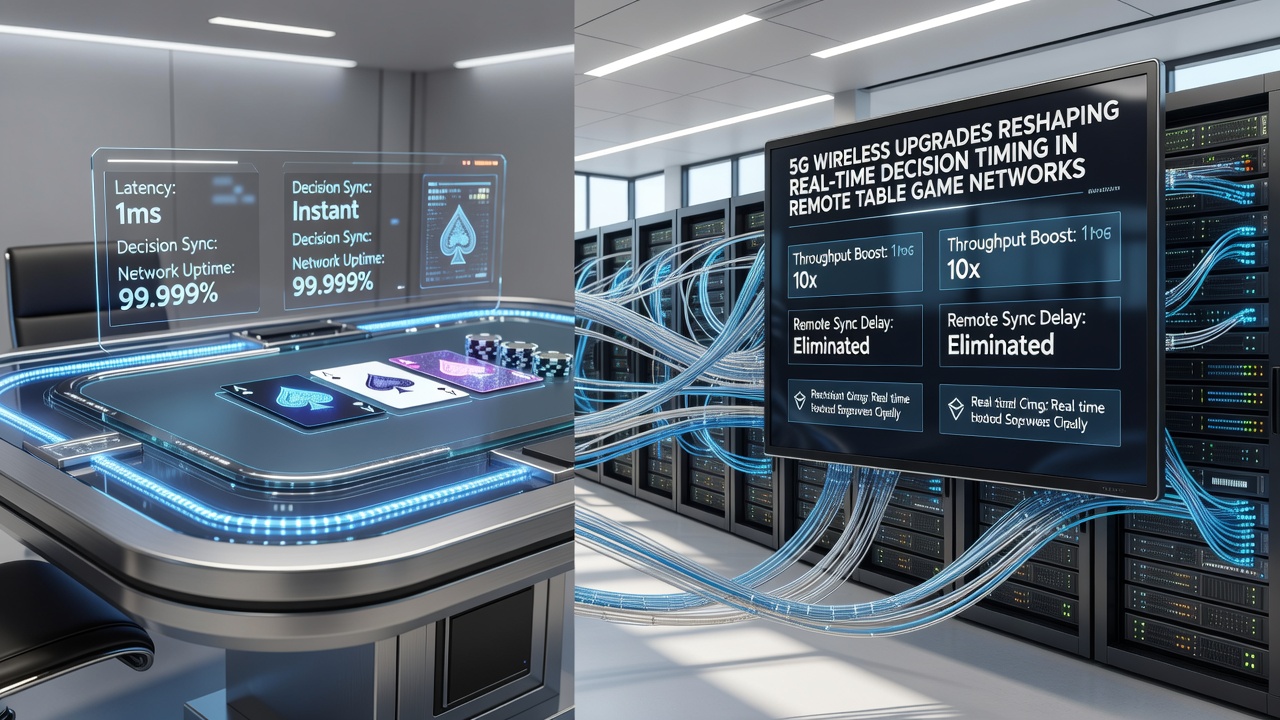
Multi-player tables benefit further because all participants receive updates in closer temporal alignment. Synchronization logs from networked studios indicate that the gap between the first and last player to see a shared event has narrowed from roughly 45 milliseconds to under 12 milliseconds on average. This compression supports simultaneous decision phases without staggered reveals that could otherwise introduce information asymmetry across remote participants.
Deployment Patterns Across Regions and Providers
Commercial rollouts in North America and parts of Asia have prioritized gaming-adjacent spectrum and edge facilities located within 30 kilometers of major data centers hosting game servers. Canadian provincial regulators overseeing remote gaming platforms have documented 5G integration timelines that align with spectrum auctions completed in 2024, while Australian authorities report similar infrastructure milestones reached by mid-2026. Network operators serving multiple casino groups note that these geographic clusters enable consistent performance for cross-border player pools without requiring separate regional server farms.
Standards bodies such as the GSM Association have published interoperability guidelines that address timing tolerances for real-time gaming traffic carried over 5G slices. Those documents specify quality-of-service parameters that prioritize low jitter and bounded delay for video and control channels, and several large-scale operators have adopted the recommended configurations in production environments. Research published through academic partnerships with telecommunications institutes further quantifies packet-loss rates below 0.01 percent under sustained gaming loads, supporting uninterrupted session continuity.
Conclusion
5G wireless upgrades continue to narrow the performance gap between on-site and remote table game participation by delivering measurable reductions in transmission latency and improved synchronization across distributed player groups. Network measurements collected through August 2026 confirm that these technical gains translate directly into preserved decision timing and consistent game pacing. Ongoing infrastructure expansion and standards refinement indicate that further incremental improvements remain achievable as coverage density and edge-computing capacity increase.